| Post Name | Veterinary Field Assistant |
| Organization | AH&V Department |
| Exam Type | Written Examination |
| Exam Mode | Offline (OMR) |
| Total Questions | 100 Questions |
| Full Marks | 100 Marks |
| Exam Duration | 2 Hours |
| Exam Standard | HSSLC (Science) |
Assam VFA Syllabus 2026
The Directorate of Animal Husbandry and Veterinary, Assam has published an official notification for the recruitment of 200 posts of Veterinary Field Assistant (VFA) and its allied cadre. For this recruitment, candidates will have to appear in a written examination covering Biology, Chemistry, Physics and General Awareness. The questions will be of Higher Secondary Science standard, with Biology carrying the highest weightage.
Candidates looking for the eligibility conditions, category-wise vacancies and application procedure can read our Assam VFA Recruitment 2026 article.
Assam VFA Syllabus Details
Post Name: Veterinary Field Assistant (VFA) and allied cadre posts
Total Posts: 200 Posts
Organization: Directorate of Animal Husbandry and Veterinary, Assam
Exam Type: Written Examination
Question Type: Multiple Choice Questions (MCQs)
Negative Marking: To be notified. The recruitment advertisement and detailed guidelines do not specify any deduction for incorrect answers.
Exam Medium: To be notified. The language of the question paper has not been specified yet.
Assam VFA Written Exam Pattern
| Subject | Marks |
|---|---|
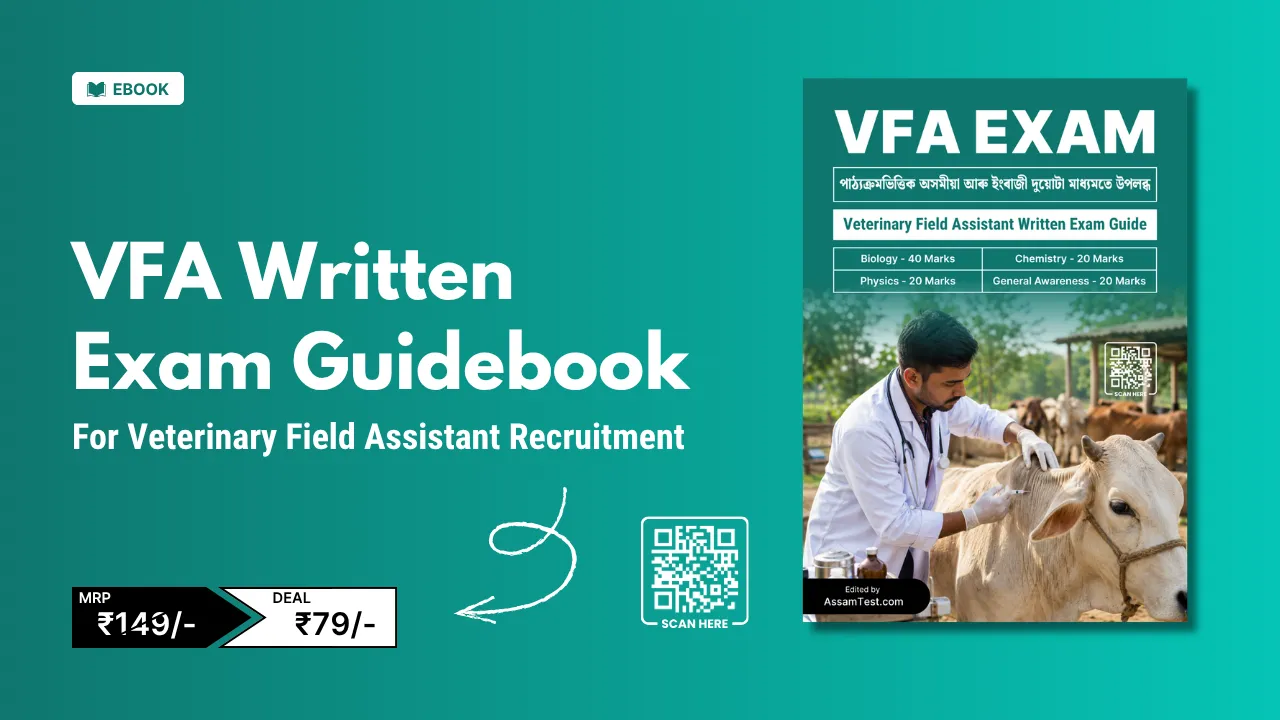
| Biology | 40 |
| Chemistry | 20 |
| Physics | 20 |
| General Awareness | 20 |
| Total | 100 |
Biology carries as many marks as Chemistry and Physics combined. It therefore deserves a larger share of revision time, although the other three subjects together still account for 60% of the paper. As of now, the chapter-wise allocation of marks within these subjects is not notified.
The allotted 120 minutes applies to the complete written examination. The notices do not prescribe a separate time limit for each subject. While practising, candidates should allow time for both solving the questions and marking their answers on the OMR sheet.
What Is the Standard of the VFA Examination?
The prescribed standard is HSSLC (Science), or Class 12. Class 9 and 10 science can help candidates revise the foundations, but preparation should also cover the relevant Class 11 and 12 concepts. Studying only lower-school general science would leave substantial parts of Physics, Chemistry and Biology uncovered.
The one-year training in Elementary Knowledge of Animal Husbandry and Veterinary Science is a separate requirement after selection. Selected candidates must complete and pass that training before appointment. It should not be confused with the written-test syllabus, which lists the four subjects shown above rather than a separate professional Veterinary Science paper.
Subject-Wise Assam VFA Syllabus
Note: The subject names, marks, and examination standard are official. The official notification does not provide a chapter-wise syllabus. We have prepared the following topic-wise outline as study guidance; it is not an official or exhaustive chapter list, and it does not predict chapter-wise marks.
Biology: 40 Marks
Biology preparation should connect the names of structures with their functions and the processes they perform. Labelled diagrams, comparisons and short process explanations are useful for revising the coverage suggested here.
Living World and Classification: Study the characteristics of living organisms, scientific naming and the hierarchy of classification. Revise the main plant groups, animal phyla and vertebrate classes through their identifying features and familiar examples. Include the broad differences among bacteria, fungi, plants and animals, along with the special features of viruses.
Cells, Tissues and Biomolecules: Cover prokaryotic and eukaryotic cells, plant and animal cells, cell organelles, diffusion, osmosis and active transport. Learn the location and function of major plant and animal tissues. Revise carbohydrates, proteins, lipids, nucleic acids and enzymes, followed by the differences between mitosis and meiosis.
Plant Structure and Life Processes: Revise roots, stems, leaves and their common modifications. Study absorption, xylem and phloem transport, transpiration, mineral nutrition and nitrogen fixation. Photosynthesis, respiration, germination, tropic movements and plant growth regulators should be understood through their purpose, main requirements and effects on plant growth.
Ecology and Environment: Study organisms, populations, communities, ecosystems, habitats and ecological interactions. Cover food chains, food webs, energy flow, ecological pyramids, decomposition and nutrient cycles. Revise biodiversity, conservation, pollution, greenhouse warming and ozone depletion. Keep conservation concepts separate from the names and locations of protected areas studied under General Awareness.
Nutrition, Breathing and Circulation: Cover nutrients, digestion, absorption and assimilation, including the major digestive organs and enzymes. Revise breathing, gas exchange, blood components, blood groups, the heart, blood vessels and lymph. Trace the movement of food, air and blood through the relevant systems; include a basic comparison of human and ruminant digestion.
Excretion, Movement and Coordination: Study the kidneys, nephron and the basic stages of urine formation. Cover bones, muscles, joints, neurons, the brain, spinal cord and reflex action. Revise the main parts of the eye and ear, together with endocrine glands, their hormones and the functions controlled by those hormones.
Reproduction: Cover sexual and asexual reproduction, vegetative propagation, flower structure, pollination, fertilisation and seed formation. Revise human reproductive organs, gamete formation, the menstrual cycle, fertilisation, implantation, pregnancy and reproductive health. Pay attention to the distinction between related processes, such as pollination and fertilisation.
Heredity and Molecular Biology: Study genes, alleles, chromosomes, genotype and phenotype, followed by Mendel’s laws and simple monohybrid crosses. Revise sex determination, sex-linked inheritance and selected genetic disorders. Cover the differences between DNA and RNA and the basic purpose of replication, transcription and translation.
Evolution and Adaptation: Revise inherited variation, mutation, adaptation, natural selection and elementary speciation. Study fossils and comparative structures as evidence of evolution, including homologous and analogous organs. The broad outline of human evolution can be included without turning revision into an extensive list of fossil dates.
Health, Disease and Immunity: Study communicable and non-communicable diseases, pathogens, parasites, hosts and vectors. For common diseases, connect the causative organism with transmission and broad prevention. Revise immunity, antibodies, vaccination, nutritional deficiencies, hygiene and public health. Distinguish a disease-causing organism from the vector that carries it.
Useful Microbes, Biotechnology and Animal Husbandry: Cover microbial uses in food production, antibiotics, sewage treatment, biogas and biofertilisers. Revise the purpose of recombinant DNA technology, PCR and familiar biotechnology applications. Basic dairy, poultry, fisheries, apiculture, breeding, feed and hygiene may be studied as school-level Biology applications; these are not separately notified written-test subjects.
Chemistry: 20 Marks
Chemistry revision should cover physical, inorganic and organic chemistry. Along with definitions, practise recognising formulas, balancing equations, identifying functional groups and using basic numerical relationships.
Matter, Atoms and the Periodic Table: Study elements, compounds, mixtures and separation methods. Revise atomic and mass numbers, ions, isotopes, electronic configuration and valency. Cover atomic mass, molecular mass, mole and molar mass through direct calculations. In the periodic table, understand groups, periods and broad trends in atomic size, metallic character and electronegativity.
Bonding, Reactions, Acids and Bases: Cover ionic and covalent bonding, simple electron-dot structures, molecular shapes and hydrogen bonding. Practise balancing equations and recognising combination, decomposition, displacement and precipitation reactions. Revise oxidation, reduction, oxidation states, acids, bases, indicators, pH, neutralisation and the uses of common salts.
Physical Chemistry: Revise basic gas laws, solutions, concentration, solubility, osmosis and colloids. Study endothermic and exothermic changes, dynamic equilibrium, Le Chatelier’s principle, reaction rates and catalysts. Include electrolytes, galvanic and electrolytic cells, electrolysis, batteries and corrosion. Begin numerical practice with direct gas-law, mole and concentration calculations.
Carbon and Organic Compounds: Study carbon bonding, saturated and unsaturated hydrocarbons, homologous series, simple nomenclature and structural isomerism. Identify the functional groups of halo compounds, alcohols, phenols, ethers, aldehydes, ketones, carboxylic acids and amines. Revise basic combustion, addition, substitution, oxidation and esterification reactions through simple examples.
Elements and Inorganic Compounds: Revise metals and non-metals, the reactivity series, basic extraction principles, alloys and familiar gases, salts and oxides. Include broad transition-element properties such as variable oxidation states and catalysis. For coordination compounds, begin with the meanings of central ion, ligand and coordination number.
Chemistry in Everyday Life: Cover the chemical classes of biomolecules, familiar polymers, soaps and detergents. Study water hardness, fertilisers, fuels and common household chemicals through their names, formulas and uses. Keep this revision connected to chemical properties, while studying the biological functions of biomolecules under Biology.
Physics: 20 Marks
Physics preparation requires both conceptual revision and numerical practice. For every formula, note the meaning of each symbol, its unit and the conditions in which the formula can be used.
Measurement and Mechanics: Revise SI units, prefixes, conversions, measuring instruments and least count. Study scalars and vectors, distance and displacement, speed, velocity, acceleration and motion graphs. Cover Newton’s laws, momentum, friction, work, energy, power, gravitation, mass and weight, elementary circular motion and torque.
Properties of Matter and Heat: Study density, pressure, buoyancy, flotation, elasticity, viscosity and surface tension through familiar situations. Revise heat and temperature, thermal expansion, specific heat, latent heat and temperature-scale conversions. Include conduction, convection, radiation and elementary thermodynamics, with straightforward calculations where applicable.
Oscillations, Waves and Sound: Understand time period, frequency, amplitude, wavelength and wave speed. Compare transverse and longitudinal waves, and connect pitch and loudness with the relevant physical quantities. Study echoes, resonance and ultrasound; practise direct wave-speed and echo-distance calculations.
Electricity and Magnetism: Cover electric charge, field, potential, capacitance, current, voltage and resistance. Practise Ohm’s law, simple series and parallel circuits, electrical power and energy. Revise magnetic fields, electromagnets, magnetic materials, the motor effect, electromagnetic induction, generators, transformers, AC/DC, fuses and earthing.
Light and Optical Instruments: Study reflection, refraction, mirrors, lenses, image formation, magnification and lens power. Practise reading ray diagrams and applying formulas with a consistent sign convention. Cover eye defects, corrective lenses, dispersion, scattering, total internal reflection, microscopes and telescopes, together with elementary interference, diffraction and polarisation.
Atomic, Nuclear and Electronic Physics: Revise the electromagnetic spectrum, photons, the photoelectric effect, atomic models and energy levels. Study alpha, beta and gamma radiation, half-life, fission and fusion. Include conductors, insulators, semiconductors, doping, diodes, rectifiers and solar cells, with simple half-life and photon-energy calculations.
General Awareness: 20 Marks
For preparation, divide General Awareness into Assam-related knowledge, broader Indian and general knowledge, and current affairs. The department has not assigned separate marks to these areas, so the grouping should be used to organise revision rather than to predict the paper.
Assam Geography, Environment and Economy: Study Assam’s location, neighbours, major valleys, hills, climate, and the Brahmaputra and Barak river systems. Revise important protected areas, wildlife, places and administrative geography. Connect tea, petroleum, agriculture and silk with their economic importance, and verify changing district or protected-area information before memorising it.
Assam History and Culture: Cover the main phases of Assam’s history, Ahom and Koch contributions, the Battle of Saraighat, the Treaty of Yandabo and Assam’s role in the freedom movement. Revise Sankardeva, Madhavdeva, important literary figures, festivals, cultural traditions and heritage sites through their contributions and significance.
Indian History and Geography: Revise major developments in ancient, medieval and modern India, with attention to the freedom struggle and its principal movements and personalities. Geography preparation can cover physical divisions, rivers, climate, soils, crops, natural resources, states and neighbouring countries.
Constitution and Government: Study the Preamble, Fundamental Rights, Fundamental Duties and Directive Principles. Understand the roles of the President, Governor, Parliament, state legislatures, judiciary and local government. Cover elections and major constitutional bodies through their functions, instead of relying only on lists of office-holders.
Economy, Institutions and General Knowledge: Revise economic sectors, money, banking, inflation and basic public-finance terms. Include the purposes of major national and international institutions, computer hardware and software, memory and storage, the internet and digital safety. Major awards, sports terms and important days can form a separate short revision list.
Current Affairs: Follow significant Assam and national developments, government initiatives, science, the environment, sports, awards and major international events. We suggest reviewing the preceding 12 months, with closer attention to the latest 6 months, and updating notes as the examination approaches. This is a preparation window, not an official cutoff.
How to Prepare for the Assam VFA Exam?
Step 1: Use the topic outline to check your Class 11 and 12 science textbooks and identify the areas you have forgotten. Return to Class 9 and 10 material only where a missing foundation prevents you from understanding the higher-secondary topic.
Step 2: Keep revision notes suited to each subject: organ and function comparisons for Biology, formulas and reactions for Chemistry, formulas with units for Physics, and dated facts for General Awareness. Review the topics in which your practice answers are repeatedly wrong.
Step 3: Attempt a complete 100-question practice test within 120 minutes, including the time spent filling an OMR sheet. Separate mistakes caused by weak concepts, calculations, misreading, and answer-sheet marking so that the next revision session addresses the actual problem.
Step 4: Check the official website link in the Important Links section for examination instructions. Confirm the negative-marking rule, paper language, and examination schedule from the department before deciding your final test-taking approach.
Important Links of Assam VFA Syllabus
| VFA Exam Guide | Click Here |
| VFA Mock Tests | Click Here |
| Official Notification | Click Here |
| WhatsApp Channel | Click Here |
| Install Android App | Click Here |
| Official Website | Click Here |
FAQs of Assam VFA Exam Syllabus
What is the syllabus of the Assam VFA written examination?
The notified subjects are Biology, Chemistry, Physics and General Awareness, at HSSLC Science standard. Biology carries 40 marks and the other three subjects carry 20 marks each.
How many questions are there in the Assam VFA exam?
The written examination has 100 multiple-choice questions for 100 marks. Candidates have 120 minutes to complete the OMR-based test.
Has the department released a chapter-wise VFA syllabus?
The advertisement and detailed guidelines specify the subjects, marks and standard, but do not provide a chapter-wise list. The topic-wise coverage in this article is preparation guidance, not an official exhaustive syllabus.
Are Class 9 and 10 science books enough for VFA preparation?
They are useful for revising the foundations, but the notified examination standard is HSSLC Science. Candidates should also prepare the relevant Class 11 and 12 concepts.
Is there negative marking in the Assam VFA exam?
The official notices reviewed do not specify negative marking. Candidates should wait for the department’s examination instructions and should not assume that wrong answers carry no penalty.
Is the one-year veterinary training part of the written examination?
No. The written examination covers the four notified subjects. Selected candidates must separately undergo and pass the mandatory one-year training in Elementary Knowledge of Animal Husbandry and Veterinary Science before appointment.

Ai topic related questions dibo
Is appointment guranteed after training? What has been the appointment: training recruitment ratio in the previous years? How have the stipends looked like for previous year post holders?
Sllybus topic wise notes